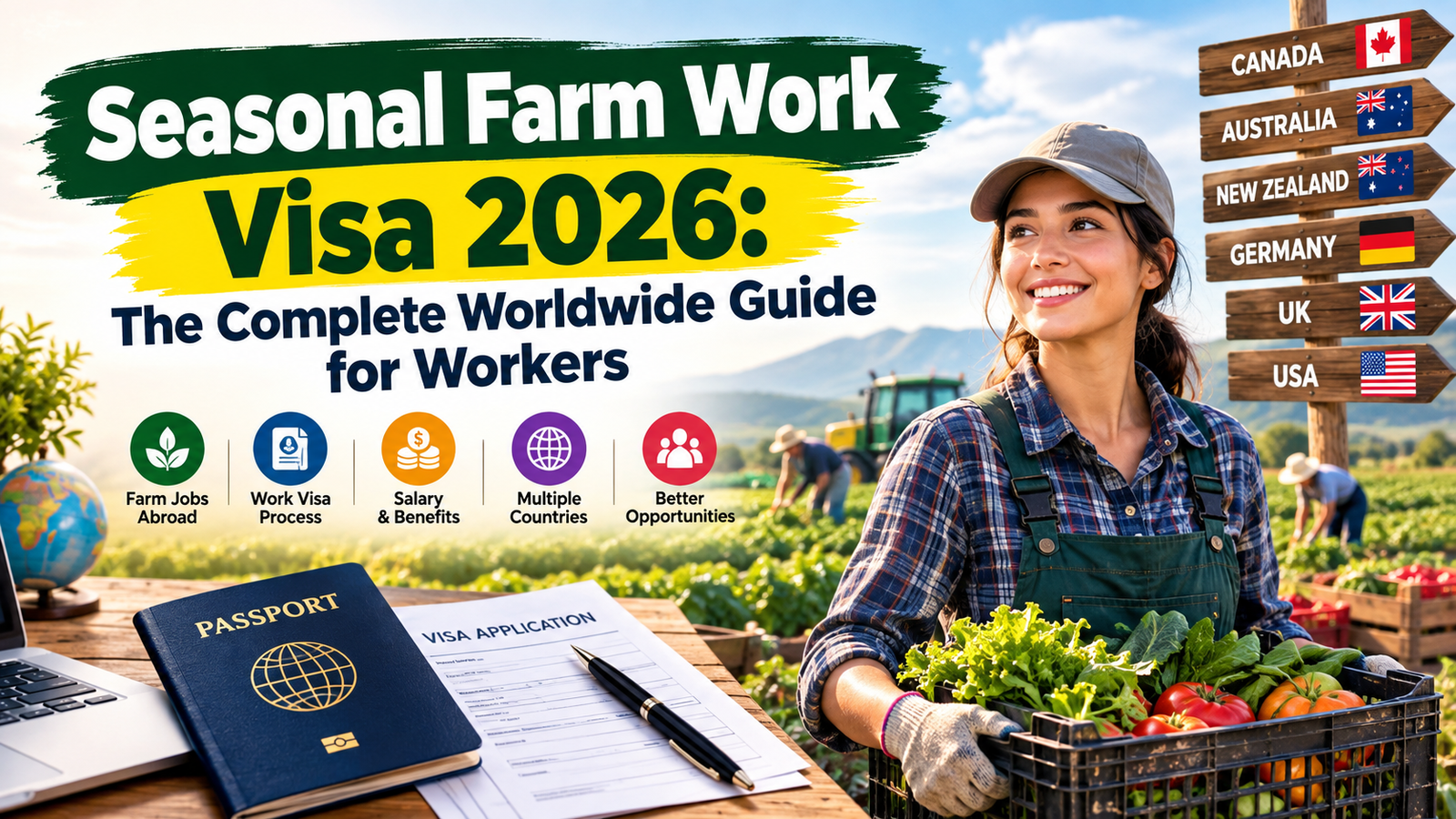
Seasonal Farm Work Visa 2026: The Complete Worldwide Guide for Workers
Ask anyone who has spent a summer picking fruit abroad what they wish they had known before they left, and the answer is a rarely about the work itself. It’s about the process: which country would actually accept them, who was supposed to arrange the visa, how much it should have cost, and the how close they came to paying someone who had no job to a offer.
This guide is written for exactly those questions. It doesn’t matter whether you live in the Asia, Africa, Latin America, Eastern Europe or the Pacific. The logic of a seasonal farm visas is the same everywhere, and once you understand it, you can judge any full offer or opportunity for yourself.
Why These Visas Exist in the First Place
Agriculture has a timing problem that most industries don’t. A factory can spread its work evenly across the year. A farm cannot. For a few intense weeks or months, a crop very needs far more people than the farm employs at any other time. Once the harvest is in, most of those jobs disappear.
Local workers in wealthier countries are often unwilling or unavailable to take short, physically demanding jobs in rural areas. Governments have therefore created special visas that let farms bring in workers from abroad for the season, on the condition that they go home when it ends. That condition shapes almost everything about how these visas work. They are temporary by design, they are tied to a real job, and they are usually managed closely by the government.
Start Here: Three Questions to Answer Before Anything Else
Before you look at job ads, answer three questions. They will save you more time and money than anything else in this article.
Is My Nationality Eligible?
This is the question most people skip, and it’s the most important one. Many seasonal programs recruit only from particular partner countries. A program can be excellent and well-paid and still be completely closed to you because of your passport. Find out first which programs accept your nationality, and set aside everything else.
Who Will Start the Process?
In almost every country, you can’t simply apply for a seasonal farm visa on your own. An employer, an approved recruiter or a government body has to select you first. Your job is to find that legitimate starting point, not a visa form.
When Does the Season Begin?
Seasonal programs run on harvest calendars. If you apply too late, the places may already be gone. If you apply too early, the employer may not be recruiting yet. Knowing the rhythm of your target country is half the battle.
Read Also ; Health Insurance Premiums for Foreign Workers 2026
Where the Doors Are Open: A Region-by-Region Look
The picture below reflects how these programs are generally set up. The details — quotas, fees, application windows and eligible countries — are revised regularly, often every year. Always check the latest version with the destination’s official immigration authority before you act.
| Region | Main destinations | How open to the world |
|---|---|---|
| Europe | UK, Italy, Spain, Greece, Portugal, Croatia, Germany | Mixed: some broadly open, others limited to partner countries |
| North America | United States, Canada | US open to listed countries; Canada’s main seasonal program is limited to specific countries |
| Asia-Pacific | Australia, New Zealand, South Korea | Mostly limited to partner countries or regions |
Europe
Europe offers the widest range of options, but also the most confusion, because each country makes its own rules.
The United Kingdom has a dedicated seasonal worker route for horticulture and poultry. It is known for being open to many nationalities, with recruitment handled by a small group of government-approved operators. Stays are short, family members cannot come, and the route does not lead to settlement.
Italy and Spain are two of Europe’s biggest agricultural producers, and both let employers hire non-EU workers for the season. Italy works through an annual quota system with fixed application dates, and seasonal agriculture places tend to be taken very quickly. Spain is known for organised recruitment in workers’ home countries and for circular arrangements, where the same workers return for several seasons.
Greece, Portugal and Croatia also issue seasonal permits. These are often tied to bilateral agreements or to employers who arrange everything for you.
Germany needs a mention because it is so often misrepresented on social media. It has traditionally filled farm jobs with workers from inside the European Union, and its seasonal routes for non-EU workers have been limited to a small number of partner countries. If you see a post promising German farm visas to “all nationalities”, be very sceptical.
North America
The United States runs the H-2A program for temporary agricultural work. Its best-known feature is that it has no fixed annual limit, so the number of workers depends on employer demand. The employer must show that local workers couldn’t be found, and usually provides housing and transport. Participation is limited to citizens of countries on a list the US government maintains and updates, so check that list first.
Canada’s long-running seasonal agricultural program recruits from Mexico and a group of Caribbean countries through agreements between governments. Workers from elsewhere sometimes reach Canadian farms through other temporary worker streams. These depend on an employer getting government approval to hire from abroad, and they are considerably harder to access without a direct connection.
Asia-Pacific
Australia and New Zealand both focus their seasonal programs on neighbouring Pacific nations; Australia also includes Timor-Leste. If you’re not from those countries, the usual way to do farm work there is a working holiday visa. Those visas are open only to younger applicants from countries with reciprocal agreements.
South Korea runs a seasonal worker visa for agriculture and fishing, with a distinctive model. Recruitment generally happens through partnerships between Korean local governments and local authorities in other countries, so access depends heavily on where you live.
How a Genuine Application Unfolds
Although the forms differ, the sequence is almost always the same.
First comes the connection. You find a legitimate employer, an approved recruiting organisation, or a government channel. In some countries, your own labour ministry or overseas employment bureau manages recruitment for partner programs, and that is often the safest place to start.
Second comes the employer’s approval. The farm usually has to prove it needs foreign workers, get government permission, or the secure a quota place. This stage is out of your hands and can take anything from a few weeks to a several months.
Third, you receive the something official that lets you apply: a reference number, an approval document or a signed contract. With that, you submit your visa all application, pay the government fee, and provide your documents and a fingerprints.
Finally, you travel and work the season. At the end, you return home. If the employer was happy with you, there is a good chance of being invited back.
Reading a Contract Like Someone Who Has Done This Before
The contract is where a good season and a bad one are usually decided. Many first-time workers skim it. Experienced workers read it the slowly, and they look for specific things.
Check how you’ll be paid, not just how much. Is it an hourly rate, a piece rate per crate or kilo, or a mix? With piece rates, find out whether the law guarantees you at least the minimum wage for your hours, as it does in many destination countries.
Look closely at the guaranteed hours. A high hourly rate means little if the contract guarantees only a few hours a week and bad weather cancels the rest.
Then read the deductions line by line. Housing, transport, meals, utilities and sometimes travel may be taken from your pay. Two offers with similar wages can leave you with very different savings once deductions are counted. The figure that matters is what you can realistically take home.
Finally, confirm the dates. Know exactly when the contract starts and the ends, and what happens if the harvest finishes early.
What It Should Cost You
A legitimate seasonal job shouldn’t leave you in debt before you arrive. As a worker, you can expect to pay for your passport, the official visa fee to the government, and possibly a medical check. In many programs the employer covers some or all of your travel, sometimes recovered later through controlled deductions.
Large payments to agents are a different matter. Many countries’ seasonal programs forbid charging workers for recruitment, because debt makes workers easy to exploit. If you’re asked for a “placement fee”, “job guarantee deposit” or “processing charge” far above the official visa fee, stop and check before you pay anything.
What a Season Actually Feels Like
Brochures show sunshine and smiling pickers. The reality is more varied.
Days often start at dawn, and especially in hot countries, where picking stops in the afternoon heat. The work involves bending, lifting, carrying and the repeating the same movements for hours. The first week is usually the hardest, as your body adjusts and your speed is the still low. By the third or fourth week, most workers find a rhythm, and a on piece-rate jobs their earnings often rise noticeably.
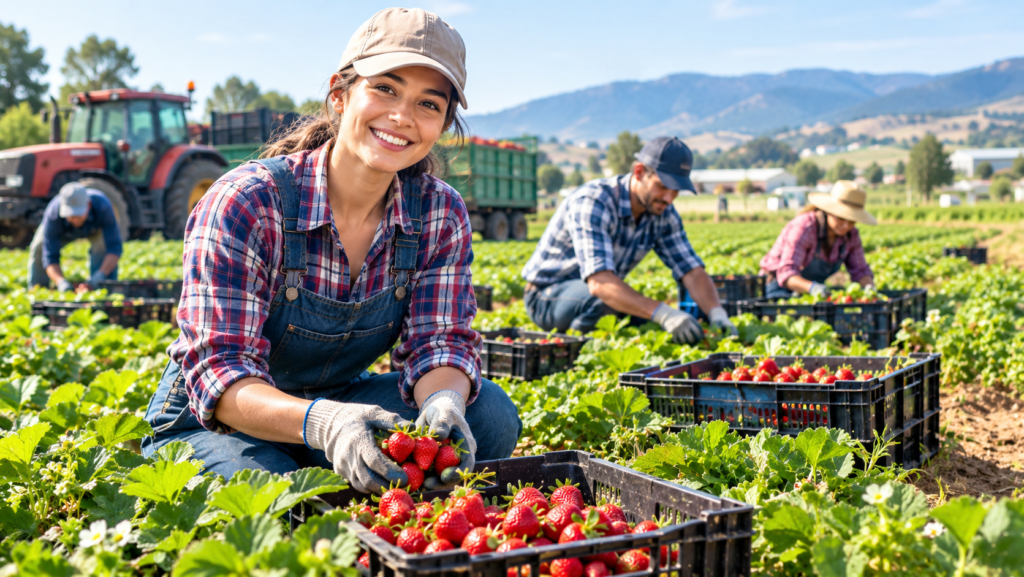
Housing is usually shared and the sometimes basic, and farms are often far from towns. Weather is the very great uncertainty: rain can stop work for a days, and which affects your hours. Many workers also say the social side surprised them. You may be sharing a kitchen with people from several countries, and friendships formed on farms often last for years.
Warning Signs of a Fake Offer
Fraud around seasonal farm jobs is the widespread, and it follows a recognisable script. The offer appears suddenly on the social media or a messaging app. The promises are generous: high wages, free housing, fast approval. Before you see any contract, you’re asked to pay, often to a personal account, with pressure to decide quickly because “seats are almost full”.
A genuine opportunity looks different. It names the farm or recruiting organisation, and you can verify that it exists. It comes with a clear written contract. It matches a program your nationality can actually join. And it doesn’t ask you to send money privately. When in doubt, check the destination government’s list of approved recruiters, or ask your own country’s overseas employment authority. Doing that costs nothing and can save you a great deal.
Making the Most of Your Season
Workers who do well tend to share a few habits. They keep their own record of hours worked and pay received, and they photograph every payslip. That makes it easy to raise mistakes calmly and with evidence. They take care of their health, because an injury in week two can cost a whole season. They send money home in a planned way rather than all at once, so they always have a small reserve.
Above all, they protect their reputation. Farms remember reliable workers and invite them back first. A clean record in one season can turn a single job into many years of income, and sometimes into better-paid roles such as supervisor or equipment operator.
Read Also : Health Insurance Premiums for Foreign Workers 2026
Can It Lead to Something Permanent?
It’s better to be honest here: for most people, a seasonal farm visa is not a route to living abroad permanently. Most are designed to be temporary and don’t count towards residence. A few countries have pathways that let experienced agricultural workers move into longer-term permits, and some employers sponsor trusted workers through separate, more demanding processes. These are exceptions, not the norm.
Going in with the realistic expectations makes the experience far better. Treat the visa as a well-defined job with an a end date, and the anything beyond that as a possible bonus.
Quick Answers to the Common Questions 2026
Do I need farming any experience?
Often not, although experience of the physical or outdoor work helps, and some employers prefer it. Honesty about your background matters more than a exaggeration.
Do I need to a speak English or the local language?
Most seasonal farm roles don’t require a formal language test. Basic communication helps with safety and teamwork, and a few roles, such as driving, may have stricter requirements.
Can I bring my family?
In almost all seasonal programs, no. They are designed for individual workers on short stays.
Can I change employers once I’m there?
Usually not freely. Most seasonal visas tie you to one employer or a group of approved employers, so choose carefully before you sign.
Is there an age limit?
Most programs require you to be an adult. Some routes, especially working holiday visas, also have an upper age limit.
Final Thoughts
Seasonal farm work in 2026 is still one of the most realistic ways for a ordinary workers to earn abroad legally, whichever country they come from. The people who benefit most are not the ones who respond very fastest to an advertisement. They check their eligibility first, work only through legitimate channels, read their contracts very carefully, and treat each season as a chance to the earn trust as well as money.
Program rules, quotas and dates change from year to year. Before you commit to anything, confirm the current details on the official immigration website of the country you hope to work in, and never pay for a promise you can’t verify.
1 thought on “Seasonal Farm Work Visa 2026: The Complete Worldwide Guide for Workers”